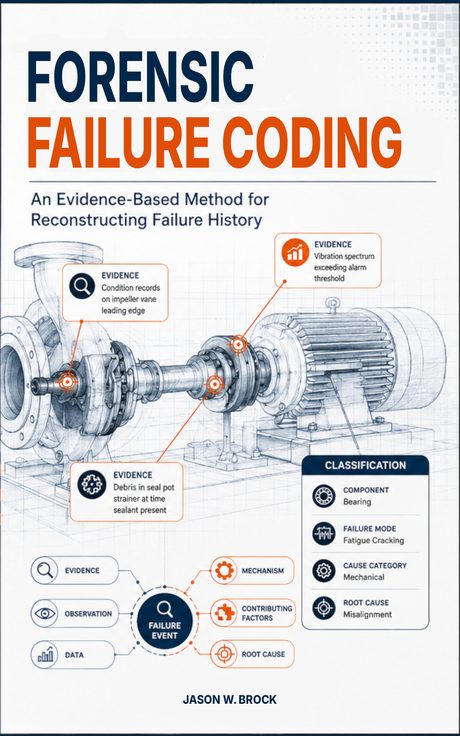
Forensic Failure Coding
Rebuilding Trustworthy Failure History from the Evidence You Already Have.
Available in hardcover, paperback, and eBook on Amazon.
Your predictive maintenance program is not stalled on the algorithm. It is stalled on the data. You already own the half nobody can rebuild, the real failure dates. This book is about recovering the half you can, the failure codes, from the evidence already sitting in and around your work orders, and grading every one by how much independent evidence stands behind it.
Every vendor in the asset space is selling the same promise: feed us your data and we will tell you when a machine is going to fail. The prize is real. The problem is that a predictive model learns from failures that already happened, in sequence, with the real gaps between them intact. Take the dates away and there is no forecast left to make. Most plants already own those dated events. What they are missing is the classification: what failed, why, and what fixed it. The codes nobody filled in, or filled in so carelessly they say nothing.
The fourth option
Forensic Failure Coding is the fourth option, the one that is not on most people's list. Not leaving the history blank, not hand-coding it by judgment no one can check, and not fabricating synthetic records that poison the model with invented dates. You rebuild the failure codes from the evidence already in and around your records, parts and BOM, work classification, narrative, the wider net of direct issues and shop teardowns, and you leave the real dates exactly where the history put them. Every code carries a confidence grade earned from independent corroboration, not from how sure a model feels. When the evidence is not there, the method says UNKNOWN instead of guessing.
Two jobs, one engine
The method does two things. It rebuilds the failure codes your history is missing, and it grades the codes already there, because an existing code is a claim, not a fact. A technician closing a work order at the end of a long shift picks the value that lets the screen close, and a confident wrong code is more expensive than an honest blank. Both jobs run through the same evidence engine. A code earns its grade from the independent evidence behind it and nothing else. Model certainty is not evidence. Looking like a thousand textbook bearing failures earns a record nothing. And UNKNOWN is a legitimate, respectable result, because a guess you cannot tell apart from a fact is worse than an honest gap.
What you will learn
- Why the wall in front of predictive maintenance is almost always the data, not the algorithm, and why the real failure dates are the half you can never rebuild
- The three bad answers to missing failure data, leave it blank, hand-code it, fabricate it, and why all three fail the temporal forecast
- How to reconstruct missing failure codes and grade existing ones through one evidence engine, since an existing code is a claim, not a fact
- The confidence model: five grades earned from independent corroboration, why UNKNOWN is legitimate, and why model certainty is not evidence
- The evidence channels, and how to assemble scattered records into one failure event without double-counting the procurement chain
- The viability gate that tells you whether to reconstruct or start clean, and how to govern the output so downstream tools consume only what they should
Who this is for
Reliability engineers and maintenance leaders sitting on years of repair history with missing or questionable failure codes. Anyone trying to feed a predictive maintenance or asset health model and finding the failure data is not there, or not trustworthy. If you have ever been told to just get it close, and known that guessing was not good enough, this book is for you.
A note on platform
This book teaches a method, not a software configuration. Forensic Failure Coding sits above any one platform. Wherever your work orders, parts transactions, and downtime live, the thinking applies. The field-level execution, the specific tables and screens for one system, lives in companion material so the method stays clean and portable.
Forensic Failure Coding is a patent-pending method developed by Jason Brock, drawn from twenty years of reliability and maintenance work in the field. The method, the opinions, and the recommendations are his. AI helped produce the book. It did not create the method.
Frequently asked questions
What is Forensic Failure Coding?
Forensic Failure Coding is a method for rebuilding the failure codes your maintenance history is missing, and grading the codes it already has, using the evidence already in and around your records. It leaves the real event dates untouched and grades every code by how much independent evidence stands behind it, so a predictive model gets failure history it can trust.
Is this the same as synthetic or fabricated failure data?
No. It never invents an event or a date. It keeps the real dated failures your history already holds and supplies only the missing classification, with a confidence grade tied to the evidence. Synthetic data invents events that never happened on dates that are made up, which poisons a forecaster that learns from timing.
Does the method code every record?
No, and that is by design. When a record carries no admissible evidence, the method marks it UNKNOWN rather than guess. A clean run does not return one hundred percent coded history. It codes what the evidence earns, grades each code by how much evidence earned it, and is honest about the rest.
Do I have to use IBM Maximo to apply this?
No. The method sits above any one platform. Wherever your work orders, parts transactions, and downtime live, the thinking applies. The field-level execution, the specific tables and screens for a given system, lives in companion material so the method stays clean and portable.
Stop feeding your predictive program data it cannot trust.
Buy on Amazon